
Where Are Savannah Cats Legal? A State-by-State Look at F4 and F5 Ownership
August 4, 2026 · 7 min read
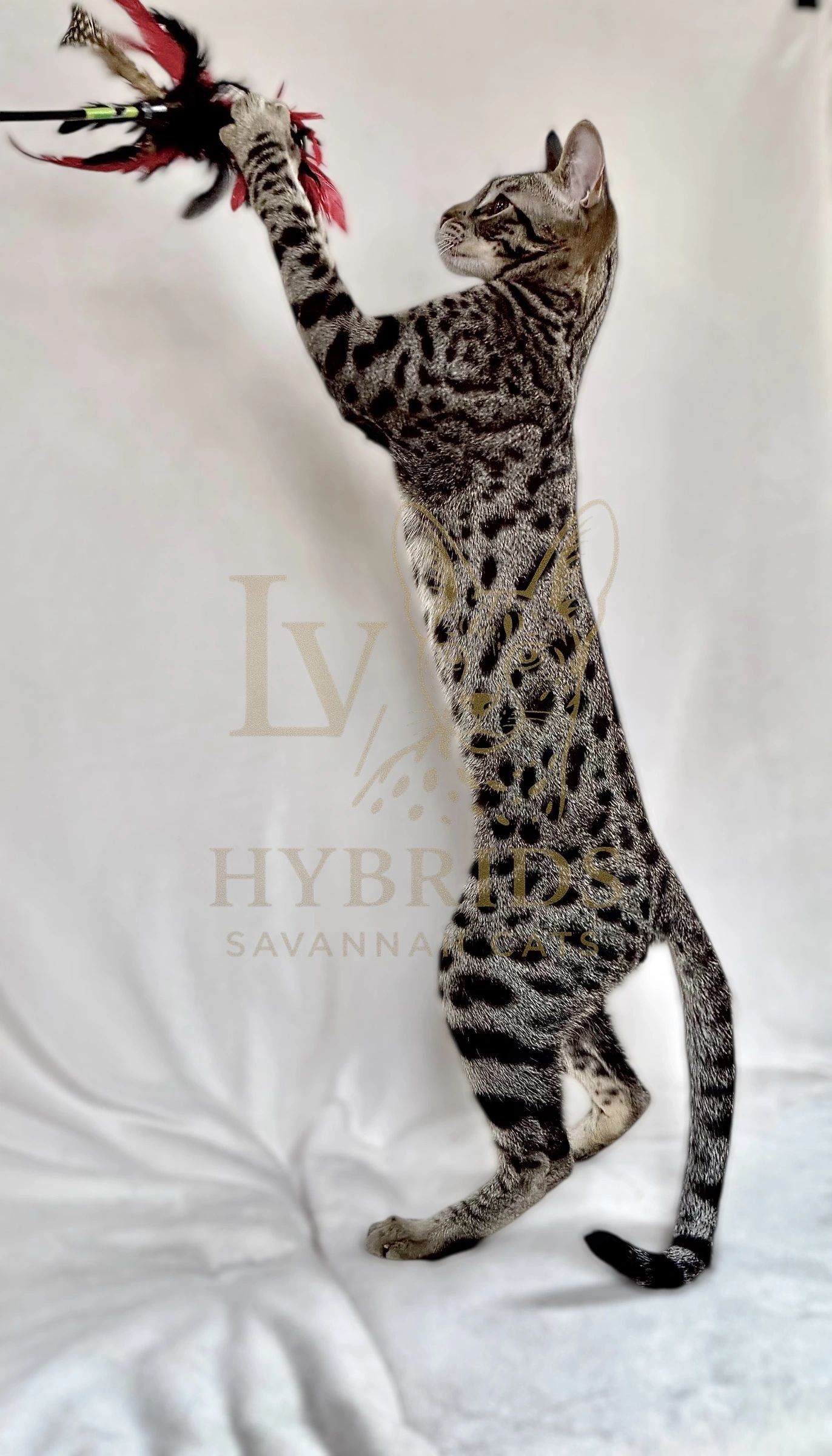
Almost every Savannah cat law in the United States is written around one idea: how much African serval is in the cat, and how many generations removed from that serval it is. That is why two people can both own "a Savannah cat" and only one of them needs a permit.
Our kittens are F4 and F5 SBT Savannahs — four and five generations removed from the serval — which is the range most states treat as an ordinary domestic cat. Early generations (F1 and F2) are the ones that trigger exotic or wild animal rules.
States that generally prohibit Savannah cats
A small number of states ban Savannah cats outright regardless of generation. As of this writing that list is Georgia, Hawaii, Nebraska, and Rhode Island. We do not place kittens into those states.
States with generation limits or permits
Several states allow later-generation Savannahs but restrict F1 through F3, or require a permit for hybrids under a certain generation. New York State allows F5 and later; New York City is stricter than the rest of the state. Massachusetts, Delaware, and Alaska have historically required permits or restricted early generations. Texas leaves much of the decision to counties and cities.
This is exactly why generation matters when you buy. An F5 SBT Savannah is the safest choice if you live in a state or city with hybrid rules on the books.
Around Nevada, the picture is simple
We are based in Pahrump near Las Vegas, and the states around us are some of the easiest in the country for Savannah ownership: Nevada, Arizona, Utah, California, Idaho, Oregon, New Mexico, and Colorado all permit later-generation Savannah cats. Many of our families drive in for pickup or meet us at the airport.
Always check your city and your landlord
- Search your city or county code for "hybrid", "exotic animal", or "wild animal" ordinances — city rules can be tighter than state law.
- If you rent, get written confirmation that a hybrid breed is allowed.
- If your state uses generation cutoffs, keep your TICA paperwork accessible — it documents your kitten's generation.
- Airlines and pet insurers may ask for the same documentation, so store a digital copy.
Where we can help
Laws change, and we are breeders rather than attorneys — treat this as a starting point and confirm your local rules. If you tell us your city, we will tell you honestly whether we think an F4 or F5 placement makes sense for you, and we will decline the sale if it does not.
Questions About Your Household?
Send an application and we will answer honestly — including telling you if a Savannah is the wrong fit.
Keep reading
Do Savannah Cats Get Along With Dogs and Other Cats?
Short answer: yes. Later-generation Savannahs are social, playful, and often become best friends with the family dog. Here is how to set them up for success at home.
F4 vs F5 Savannah Cat: Which Generation Should You Actually Buy?
F4 or F5? Side by side, an F4 and F5 can be the same size — an F4 can be bigger, or an F5 can be bigger — and there is no way to tell a Savannah cat's generation without a pedigree. It always boils down to personality. Here is how we help families choose between the two generations we breed.