
The complete breed guide
Savannah Cat Guide
Everything a first-time Savannah owner asks us: what each generation from F1 to F8 actually means, how big Savannah cats get, coat colors including silver and white snow Savannahs, how the African serval fits in, what Savannah kittens cost, and where the breed is legal. Written by an active TICA registered SBT Savannah breeder.
Filial generations
F1 To F8 Savannah Cat Generations Explained
The "F" number tells you how many generations a Savannah cat is removed from its African serval ancestor. An F1 has a serval parent. An F2 has a serval grandparent, an F3 a serval great-grandparent, and so on. As the number rises, serval percentage drops, size becomes more manageable, and temperament becomes more predictable — but a well-bred later generation can still look strikingly wild.
SBT (Stud Book Tradition) means at least three generations of Savannah-to-Savannah breeding with no recent outcrossing. Every kitten we produce is SBT, which is why our temperaments and coats are consistent litter after litter.
| Generation | Serval content | Adult size | What living with one is like |
|---|---|---|---|
| F1 | 50% or more serval | Males up to 30–40 lbs · very tall, long legged | The most exotic and the most demanding. F1 Savannahs are strongly bonded to one person, need enormous stimulation, and are best suited to experienced exotic owners with dedicated space and time. |
| F2 | About 25–37% serval | 16–22 lbs | Still large and wild looking, but somewhat easier to live with than an F1. Males are typically sterile and are placed as pets. Restricted in more states than later generations. |
| F3 | About 12–19% serval | 14–18 lbs | A middle ground: exotic build with a friendlier, more household-adaptable personality. Often the earliest generation permitted in restrictive states. |
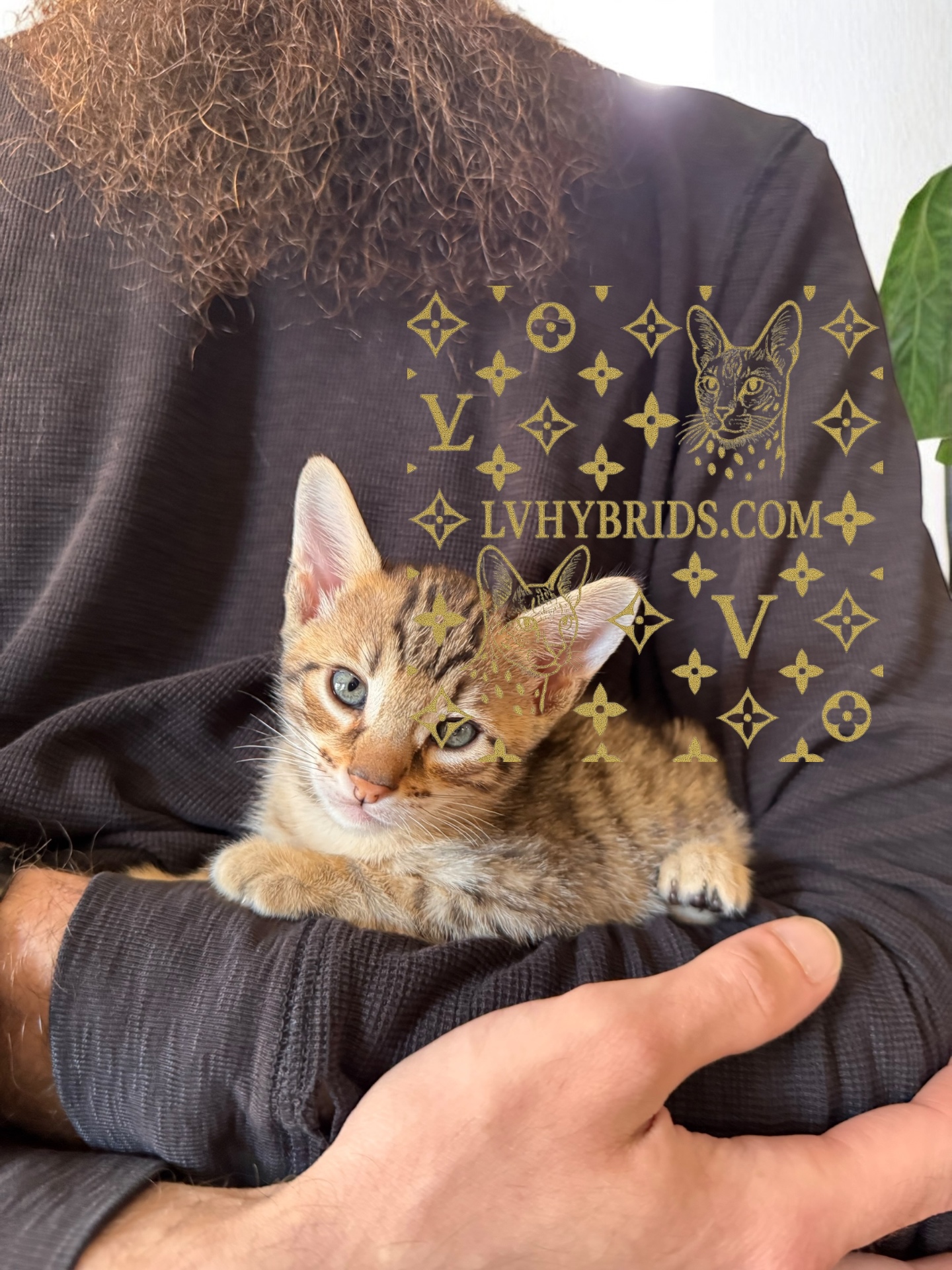
| F4 | About 6–12% serval | 13–17 lbs | Our specialty alongside F5. F4 SBT Savannahs keep the long body, big ears, and bold spotting while being fully family friendly — great with kids, dogs, and people who work regular jobs. |
| F5 | About 3–6% serval | 11–16 lbs | The most household-friendly Savannah with a still-striking spotted look. Confident, playful, dog-like, and the easiest generation to own legally almost anywhere in the United States. |
| F6–F8 | Under 4% serval | 10–15 lbs | Later SBT generations look and behave much like an F5. Personality and coat quality now come from the breeding program itself rather than the serval percentage. |
Wondering about F1 vs F5 Savannah cats specifically? An F1 is a part-wild animal that will reorganize your household around it. An F5 SBT is a domestic cat with an exotic coat that will follow you room to room, walk on a harness, and sleep in your bed. For almost every family that contacts us, F4 or F5 is the right answer.
Coats & patterns
Savannah Cat Colors
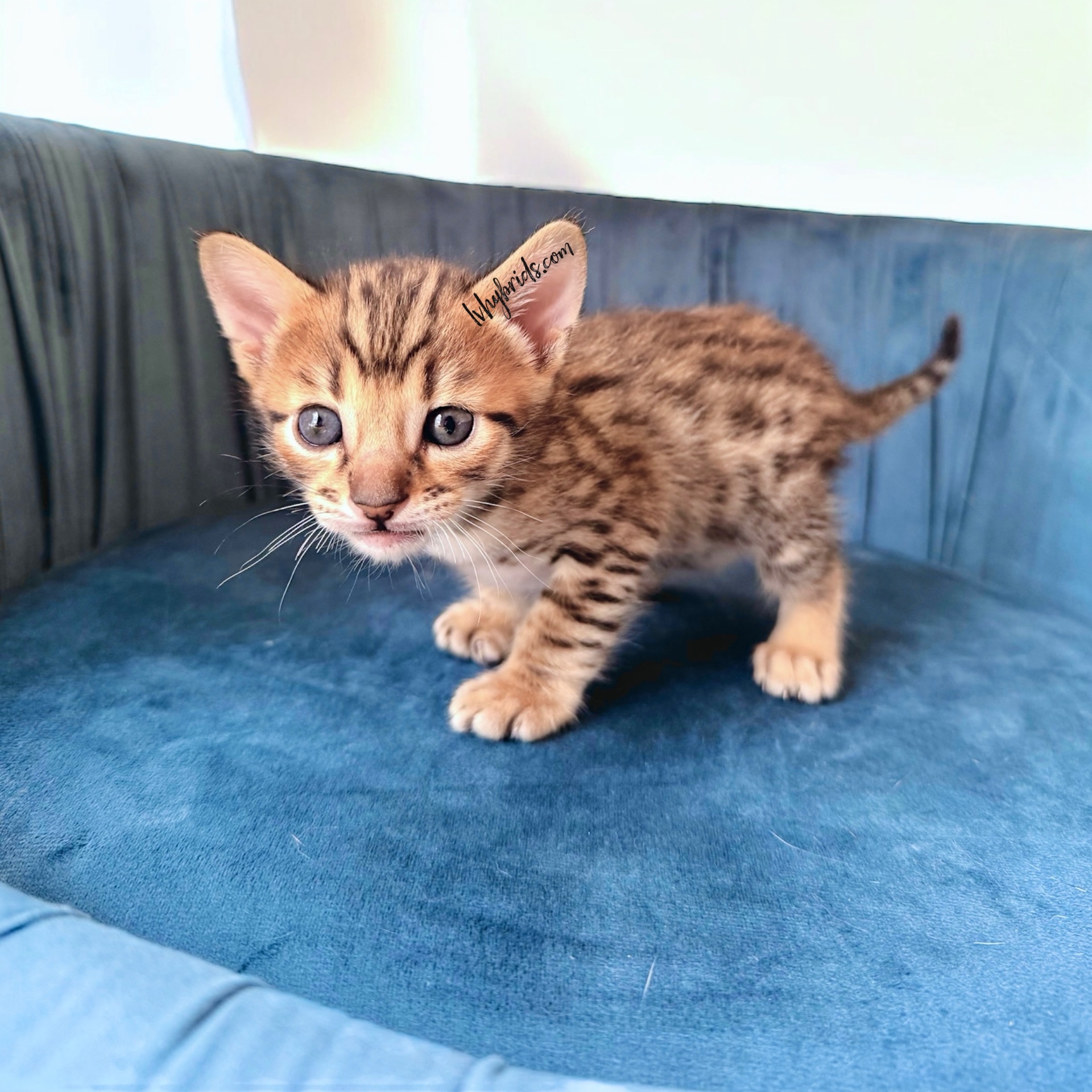
Brown spotted tabby
The classic and TICA-preferred Savannah color: warm golden to cool tan coat with solid dark brown or black spots. This is what most people picture when they picture a Savannah cat.
Silver spotted tabby
A cool silver-grey base with black spotting. Silver Savannahs photograph dramatically and have become one of the most requested looks.
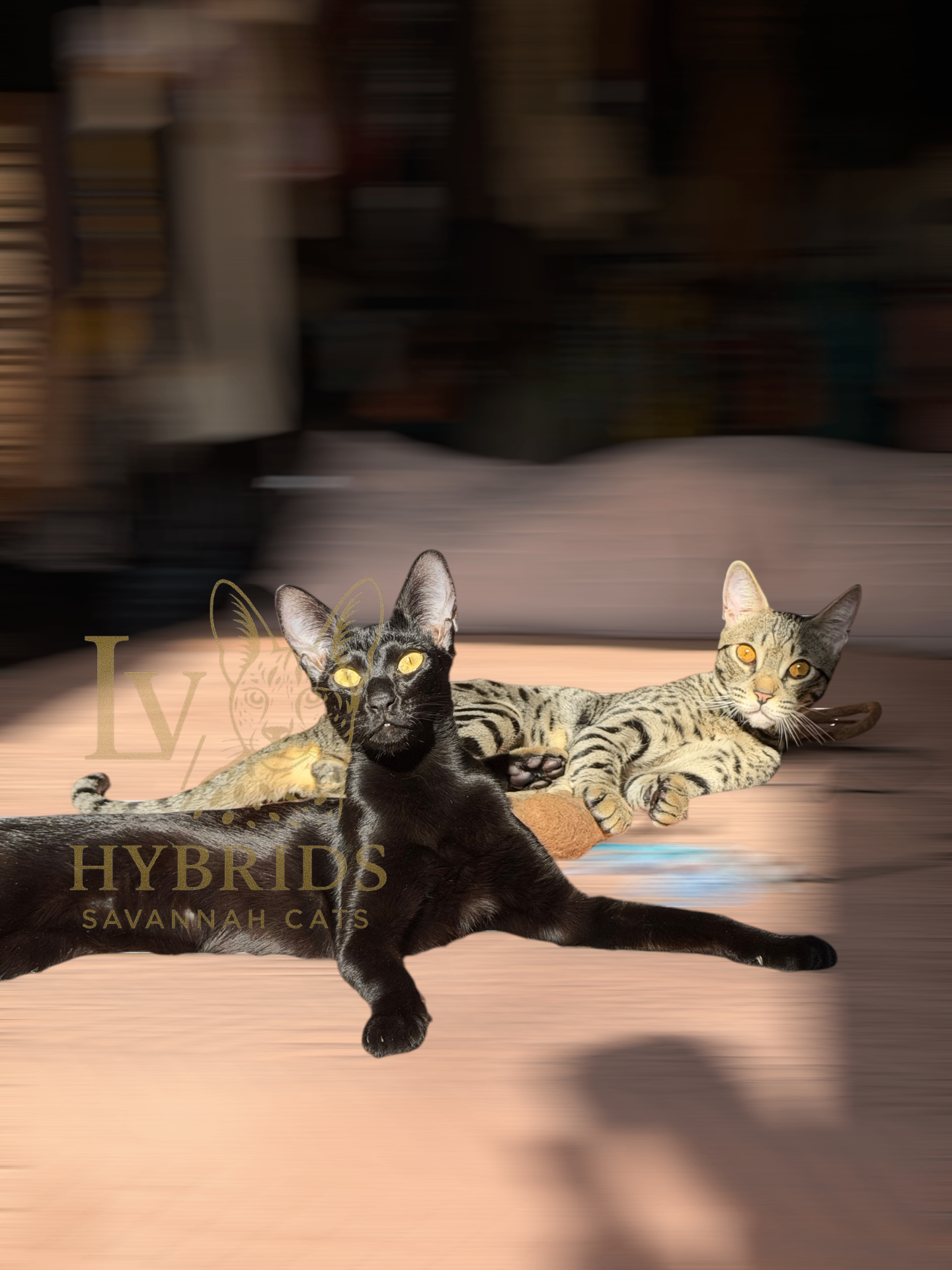
Black (melanistic)
Solid black cats where the spotting is still visible in direct sunlight — often called a ghost pattern. Rarer and highly sought after.
Snow / white Savannah cat
People searching for a "white Savannah cat" are usually looking for a snow Savannah — a pale cream or ivory coat with faint tan spotting and blue eyes. Truly white Savannahs do not occur in the breed standard; snows are the closest and are non-standard for show but popular as pets.
African serval ancestry
Where The Serval Look Comes From
The African serval is a mid-sized wild cat native to sub-Saharan Africa — roughly 25–40 lbs, extremely long legged, with huge upright ears and bold black spots on a golden coat. Crossing a serval with a domestic cat in the 1980s created the Savannah breed, and every modern Savannah traces back to those crosses.
People search for a "serval cat for sale" or an "African serval kitten" because they want that look. What they usually do not want is the reality: servals spray heavily, need large secure outdoor enclosures, require whole-prey diets, are illegal or permit only in most states, and are almost impossible to place with a normal veterinarian. They are wild animals, not pets.
An SBT F4 or F5 Savannah is how you get the serval aesthetic in an animal that is legal, insurable, litter trained, vet-friendly, and genuinely affectionate with your family.
You may also see the "Ashera cat" advertised at extraordinary prices. Ashera is a marketing name, not a recognized breed — DNA testing has shown Asheras to be Savannah cats. If someone is quoting you $20,000+ for an Ashera, you are being charged a brand premium on a Savannah.
Cost
Savannah Cat Prices By Generation
Savannah cats for sale and Savannah kitten prices track generation, sex, coat quality, and breeder reputation. Across reputable US catteries, F1 kittens commonly run $12,000–$20,000+, F2 $6,000–$12,000, F3 $4,000–$6,000, F4 around $4,000–$5,000, and F5 around $2,500–$4,000. Prices far below those ranges are usually a warning sign.
At LVHYBRIDS, F5 SBT kittens start at $2,500 and F4 SBT kittens start at $4,000, with TICA papers, a 2-year genetic health guarantee, 1 year of FIP coverage, vaccines, deworming, microchip, carrier, and a lifetime of breeder support included.
See full pricing & what's includedState laws
Where Savannah Cats Are Legal
Later-generation SBT Savannahs (F4, F5 and beyond) are treated as domestic cats in the large majority of the United States. We are able to place kittens with families in Nevada, California, Arizona, Utah, Idaho, Oregon, Washington, Montana, Wyoming, Colorado, New Mexico, Texas, Oklahoma, Kansas, Missouri, Arkansas, Louisiana, Mississippi, Alabama, Tennessee, Kentucky, Florida, South Carolina, North Carolina, Virginia, West Virginia, Maryland, Delaware, Pennsylvania, New Jersey, New York, Connecticut, Vermont, New Hampshire, Maine, Massachusetts, Ohio, Indiana, Illinois, Michigan, Wisconsin, Minnesota, Iowa, North Dakota and South Dakota.
Savannah ownership is restricted or prohibited outright in Georgia, Hawaii, Nebraska, Rhode Island, and several cities — including New York City and Denver — have their own rules that can be stricter than the state. Early generations (F1–F3) face far more restrictions than F4–F5.
Laws change. Always confirm current state, county, and city ordinances before reserving, and we will help you check before you place a deposit.
Ready when you are
Talk To A Real Savannah Breeder
We raise SBT F4–F5 Savannah kittens underfoot in our home in Pahrump near Las Vegas, Nevada, and place them with screened families nationwide. Questions about generations, legality, or which kitten fits your household? Text 702.918.6979 or apply below.